
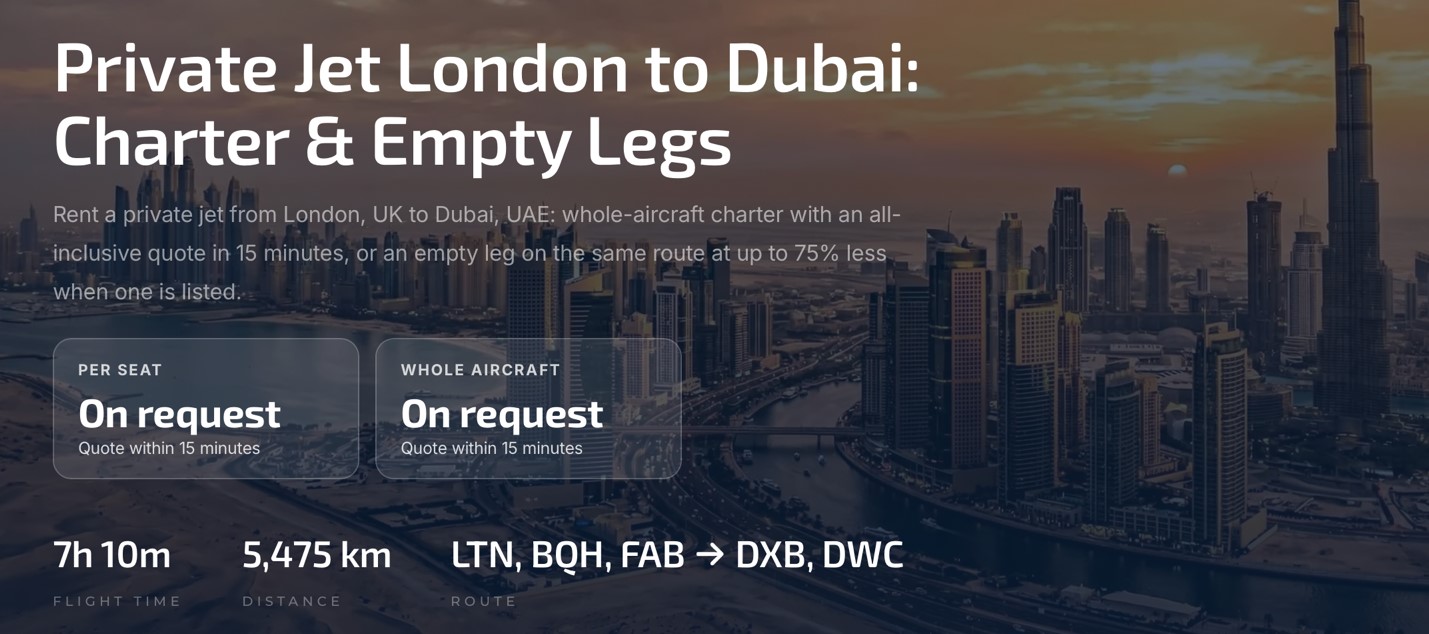
The journey from London to Dubai is long enough for the choice of aircraft to make a substantial difference. Passengers may spend seven hours or more in the cabin, making seating arrangements, workspace, luggage capacity and opportunities to rest important considerations. Travellers comparing private charter options can examine the route at https://rentjet.eu/routes/london-to-dubai/, where flight information and quotation arrangements are available. Unlike a short European flight, this journey requires careful attention to aircraft range and the practical details of spending much of the day in the air.
London and Dubai are connected by extensive business, financial and personal relationships. Executives travel between corporate offices, families divide their time between the two cities, and visitors arrive for holidays or extended stays. Scheduled airlines offer frequent connections, including premium cabins, but private aviation provides an alternative for passengers who need greater control over departure arrangements or prefer to travel with a particular group.
Flying privately does not mean that every aircraft is suitable for the route or that all operational restrictions disappear. Long-distance charter planning involves matching the aircraft to the journey, selecting appropriate airports and understanding the costs associated with international operations. The quality of the experience depends on those decisions rather than on the private jet label alone.
Choosing an Aircraft for a Seven-Hour Flight
The distance between London and Dubai is approximately 5,475 kilometres, depending on the airports and routing used. RentJet provides an indicative flight duration of seven hours and ten minutes, although actual times vary with winds, aircraft performance and air traffic arrangements. This is considerably longer than a flight between London and most European destinations, placing different demands on the aircraft.
Light jets are generally unsuitable for operating this route nonstop. Their limited range means that one or more refuelling stops would be required, potentially adding substantial time to the journey. Some midsize and super-midsize aircraft may also need a fuel stop, particularly when carrying more passengers and luggage. Aircraft performance must be assessed for the proposed itinerary rather than relying exclusively on a manufacturer’s published maximum range.
Heavy and ultra-long-range jets are better suited to nonstop flights between the two cities. Aircraft such as the Gulfstream G650 family, Bombardier Global series and Dassault Falcon 8X offer the range and cabin capacity commonly associated with longer international charters. Their precise capabilities differ, and the operator must establish whether a particular aircraft can complete the flight with the required payload and fuel reserves.
Cabin configuration matters almost as much as range. One aircraft may be arranged primarily for meetings, with seats facing a central table, while another offers separate areas for dining and rest. Two jets with similar passenger capacities can provide noticeably different experiences during a long flight.
A group of executives may value a cabin where several people can work together, while a family travelling overnight might prefer suitable sleeping arrangements. Passengers should request the actual cabin configuration and, where available, photographs of the proposed aircraft. A model name alone does not establish what facilities will be present.
Luggage requirements should also influence the decision. Travellers visiting Dubai for several weeks may carry substantially more baggage than passengers attending a short business meeting. Although larger jets generally offer greater storage capacity, weight and balance limitations still apply. The operator needs accurate information about passengers and luggage before confirming aircraft suitability.
Comfort and Productivity During the Journey
Seven hours in an aircraft cabin provides time to work, eat, read or rest, but the available facilities depend on the selected jet. Private aviation offers a degree of control over the cabin environment that scheduled air travel cannot reproduce in the same way. Passengers travelling together can decide how to use the space without sharing it with unrelated travellers.
For business passengers, the seating arrangement can be particularly valuable. A cabin fitted with a conference table may accommodate discussions or document reviews during the flight. However, the aircraft is not automatically a fully equipped office. Power outlets, connectivity and the available workspace vary between aircraft, and these details should be checked when comparing quotations.
Internet access deserves specific attention. Some long-range private jets provide satellite connectivity, but bandwidth, coverage and reliability differ according to the installed equipment and service provider. Streaming, large file transfers and video conferences may not be supported consistently throughout the journey. Travellers who need to work online should confirm the aircraft’s actual capabilities rather than assuming that Wi-Fi is included.
Rest facilities are another consideration. Certain aircraft have divans or seats that convert into sleeping surfaces, while others provide only reclining seats. Larger cabins may include separate sleeping areas, depending on the interior configuration. Passengers planning to sleep during an overnight flight should verify the number and type of usable sleeping positions.
Cabin catering can be arranged to suit the duration and timing of the flight. On a journey of this length, passengers may prefer a full meal, lighter refreshments or food served at particular times. Dietary requirements should be communicated before departure, especially when specialised catering is needed.
The most useful cabin features depend on the itinerary. A traveller arriving in Dubai for an early business meeting may place greater value on rest, while a group flying during the daytime might prefer dining and workspace. Choosing a suitable aircraft involves understanding how passengers intend to spend the journey rather than requesting every available amenity.
London Departures and Dubai Arrival Airports
Several airports around London accommodate long-range business aviation. Luton, Farnborough and Biggin Hill are among the options, although their suitability depends on aircraft type, operating restrictions and the passenger’s departure location. The airport that is geographically closest may not offer the most appropriate aircraft or departure time.
Farnborough specialises in business aviation and provides facilities designed for private aircraft operations. It can be convenient for passengers based in Surrey and southwest London, but its operating hours must be considered carefully. Luton offers established private aviation handling alongside commercial airline services and may suit passengers travelling from northern parts of the capital.
Biggin Hill is another option, particularly for passengers based in south or southeast London. However, its runway characteristics and operating restrictions must be assessed against the performance requirements of the selected aircraft. A jet capable of flying nonstop to Dubai may still face payload limitations at a particular departure airport.
In Dubai, the two principal airports to consider are Dubai International, known as DXB, and Al Maktoum International at Dubai World Central, known as DWC. Both can support business aviation operations, subject to the relevant permissions and handling arrangements. They are located in different parts of the emirate, which can make the choice important for the final ground transfer.
Dubai International is closer to several established business districts and central areas of the city. It can therefore be convenient for travellers heading towards Downtown Dubai, Deira or locations near Dubai Creek. However, the airport also handles substantial commercial traffic, and private aviation movements must comply with its operating procedures and available capacity.
Al Maktoum International is situated farther southwest, closer to Dubai South and relatively convenient for some destinations around Dubai Marina and Jebel Ali. It has dedicated general aviation infrastructure and specialist handling providers. Depending on the passenger’s final destination, it may offer a more practical arrival point than Dubai International.
Ground transport should be arranged with the actual arrival airport in mind. Dubai’s road network is extensive, but traffic conditions and journey distances vary considerably. A traveller staying near Downtown Dubai may have different priorities from someone visiting a property on Palm Jumeirah or attending meetings in Dubai South.
What Determines the Cost of a London–Dubai Charter?
Private charter pricing is based on the aircraft and the operational requirements of the journey rather than a fixed fare per passenger. The London–Dubai route involves a relatively long flight, so fuel consumption, aircraft category and crew arrangements are substantial elements of the cost. A heavy jet and an ultra-long-range aircraft may offer different cabin facilities and operating expenses even when both can complete the journey nonstop.
Aircraft positioning is another important factor. If a suitable jet is already available near the selected London airport, the operator may be able to arrange the charter without a lengthy additional flight. If the aircraft must travel from another location to collect passengers, those positioning expenses can affect the quotation.
International operations introduce further considerations. Overflight permissions, airport handling, navigation charges and ground services must be arranged according to the proposed route. The operator is responsible for the necessary flight planning, but the commercial quotation reflects the resources required to complete the journey.
Return flights require careful comparison. An aircraft may remain in Dubai for a relatively short visit, but longer stays can create parking and crew accommodation expenses. Alternatively, the operator may send the aircraft elsewhere and arrange a separate movement for the return journey. The least expensive solution depends on aircraft availability and existing assignments.
Passengers should understand what the quotation includes before comparing offers. RentJet advertises all-inclusive pricing covering the aircraft, crew, fuel, landing and handling charges, taxes, standard catering and VIP terminal access. Additional arrangements, including specialist catering or ground transport, should be confirmed separately where required.
A complete enquiry should provide enough information for the broker to identify appropriate aircraft and prepare a meaningful comparison.
- Travel dates and times. Specify the preferred departure and arrival schedule, including any acceptable flexibility.
- Passenger numbers. Confirm the number of adults, children and infants travelling.
- Cabin requirements. Explain whether the passengers need workspace, sleeping facilities or a particular seating arrangement.
- Luggage details. Include the number of suitcases and any unusually large or heavy items.
- Airport preferences. Identify the most convenient London departure point and intended destination within Dubai.
- Return arrangements. Provide the planned length of stay and any requirements for the return journey.
These details allow the broker to assess aircraft range, capacity and positioning requirements. They also reduce the likelihood of comparing quotations for aircraft that provide substantially different services.
Empty leg flights may occasionally offer an alternative for passengers with flexible travel plans. These arise when an aircraft needs to reposition and has capacity available for paying passengers. Discounts can be substantial, potentially reaching 75% below a conventional charter, but availability depends entirely on existing aircraft movements.
A suitable empty leg between London and Dubai should not be assumed to exist for a particular date. The route and departure time are controlled by the operator’s schedule, and changes to the underlying charter can affect the flight. For travellers attending fixed meetings or travelling with non-refundable arrangements, a dedicated charter may provide more appropriate scheduling control.
Preparing for an International Private Flight
Private aviation can offer a more direct passenger experience, but travelling between the United Kingdom and the United Arab Emirates remains subject to international entry requirements. Passports, visas and immigration procedures apply regardless of whether passengers use a commercial airline or a private aircraft.
British citizens travelling on full British citizen passports generally need at least six months of passport validity remaining when entering the UAE. For eligible short visits, a visitor visa can ordinarily be obtained on arrival. Requirements differ according to nationality, residence status and purpose of travel, so passengers should check the applicable rules before departure.
The operator or broker will usually request passenger details in advance to complete the necessary flight documentation. This may include names, nationalities, passport information and other information required by the relevant authorities. Providing accurate details early helps prevent avoidable problems during the final stages of preparation.
Travellers carrying unusual equipment or valuable items should discuss customs requirements before the flight. Private aviation does not exempt passengers from customs declarations or restrictions on imported goods. The same principle applies to medication, pets and other items that may require additional documentation or approval.
Time differences should also be considered when planning arrival arrangements. Dubai operates on Gulf Standard Time throughout the year, while the United Kingdom changes between Greenwich Mean Time and British Summer Time. The difference is therefore four hours during the UK winter and three hours during British Summer Time.
A flight leaving London in the afternoon may arrive in Dubai late in the evening or after midnight local time. This can affect hotel check-in, meeting schedules and ground transport arrangements. Travellers should confirm whether the quoted departure and arrival times are expressed in local time, particularly when reviewing complex itineraries.
Planning a long-distance private flight also means accounting for possible operational changes. Weather, airspace restrictions, aircraft maintenance requirements and airport availability can influence the schedule. Travellers with important commitments should allow reasonable margins rather than arranging essential meetings immediately after their anticipated arrival.
Choosing the Right Flight for the Journey
The main advantage of chartering a private aircraft between London and Dubai is the ability to shape the journey around specific requirements. Passengers can request a suitable departure airport, select an aircraft according to group size and cabin preferences, and arrange an itinerary that may be difficult to reproduce using scheduled services.
For a business group, this might mean travelling together after a day of meetings and using the flight for preparation or rest. For a family, the priorities may involve suitable seating, luggage capacity and a convenient arrival airport. Other passengers may place greater importance on privacy or the ability to organise several destinations within one itinerary.
These benefits should be weighed against the alternatives. Commercial airlines operate frequent London–Dubai services, including premium cabins with substantial comfort and rest facilities. For individuals and couples travelling on straightforward schedules, a scheduled flight may offer better financial value without creating significant practical inconvenience.
Private charter is more likely to justify its cost when the journey involves specific scheduling requirements, a larger travelling party or a need for cabin arrangements that commercial services cannot provide. Even then, passengers should compare aircraft specifications and contract conditions rather than relying on broad descriptions of luxury.
A carefully selected aircraft can make seven hours in the air productive, restful or simply more comfortable. Yet the quality of a long-distance charter depends equally on details outside the cabin, from the departure airport and ground transfers to immigration requirements and return-flight planning.
For a journey between two major international business centres, those practical choices matter more than impressive aircraft specifications alone. The right charter is one that can complete the route safely, accommodate everyone and their belongings, and deliver passengers to the most convenient airport at a time that suits the purpose of their visit.